
A Witch's Guide to Perimenopause
Hetty Lovejoy Has Words About Our Hot Flashes (And She's Right About All of Them) 🔥🌿

A note from Daisy, written from the floor of my kitchen at 2 a.m. because the tiles are cold and the bed is a furnace and I have lost all dignity:
I had a post planned for this month. It was going to be about writing rituals, or gothic summer reading, or something appropriately on-brand and pulled-together. Instead, I’m lying on linoleum in my knickers at an hour no civilised person should be conscious, radiating heat like a haunted furnace, and questioning every life choice that led me to this moment.
It’s summer. I’m in perimenopause. These two things should not coexist, and yet here we are — sweating through sheets, forgetting words mid-sentence, experiencing emotions that arrive like weather systems with no forecast, and occasionally wanting to set things on fire for reasons I cannot articulate but feel very strongly about.
I was going to write something wry and self-deprecating about all this, but honestly? I don’t have the energy. I’m tired in a way that sleep doesn’t fix. I’m hot in a way that ice doesn’t touch. And I’m fairly certain my body has been taken over by an entity with its own agenda and no interest in consulting me about the schedule.
So I’m handing this one over.
There’s a character in my books — Hetty Lovejoy, 73, witch, retired baker, keeper of secrets, owner of a sigil-carved cane and a raven called Marigold who knows everyone’s business. Hetty has been through The Change. She has zero patience for anyone who treats it as decline, embarrassment, or something to be whispered about behind closed doors.
She smells of lavender and cloves and old spellbooks, and she would like a word.
I’m giving her the newsletter. Goddess help us all.
— Daisy 🖤
Right then. Sit down. Have a scone. No, not that one — the one with the rosemary and the sea salt. It’s got a calming charm baked in, and from the look of you, you need it.
I’m Hetty. Daisy’s told you about me, though I suspect she’s left out the important bits. Writers always do — all atmosphere and not enough practical advice. Lovely girl, but she’d describe the fire in exquisite detail while forgetting to mention the exit.
So let’s talk about the thing she’s too busy lying on her kitchen floor to talk about properly.
The Change.
Not the euphemism. Not the hushed, apologetic, “oh, you know, women’s troubles” nonsense that makes me want to take my cane to something load-bearing. The actual thing. The transformation that every woman who lives long enough will walk through, and that nobody — not your mother, not your doctor, not the entire collected wisdom of the internet — adequately prepares you for.
Here’s what they don’t tell you, and here’s what I will, because I’m seventy-three and I’ve buried my tolerance for polite fiction alongside my last hot flash.
On the Heat 🔥
They call them hot flashes, which is like calling a thunderstorm “a spot of damp.” A hot flash is your body deciding, without consultation or warning, that your internal temperature needs to be roughly that of a bread oven set to prove. You will sweat through clothing you only just put on. You will radiate warmth that other people can feel from across the room. You will stand in front of open freezers in supermarkets and not care who’s watching, because dignity is a luxury and you are currently on fire.
In summer, this is particularly delightful. The world is already hot. Your body is already hot. Together, you and the season create a combined thermal event that could reasonably be classified as a hazard.
Here’s what I want you to know: the heat is not malfunction. I know it feels like malfunction. I know it feels like your thermostat has been sabotaged by someone with a grudge. But think of it as recalibration. Your body has spent decades regulating itself around a cycle it no longer needs, and now it’s burning off the old settings to make room for the new ones. It’s not comfortable. Recalibration never is. But it’s not destruction. It’s a clearing.
In the meantime: cold flannels on the back of the neck. Peppermint tea, iced if you can stand it. Cotton everything. And if anyone suggests you’re “overreacting,” you have my full permission to describe your symptoms in vivid, unflinching biological detail until they leave the room. Works every time.
On the Rage 😤

Ah, the rage. My favorite part, and I mean that sincerely.
You will be told — by magazines, by well-meaning friends, by the kind of social media account that uses the word “wellness” without irony — that the mood swings of perimenopause are a symptom to be managed. That the anger isn’t real. That it’s hormonal, and therefore irrational, and therefore something to apologize for.
I would like to be very clear about this: the rage is real, and the rage is right.
What’s happening is not that your emotions have broken. What’s happening is that the patience you’ve been running on — the decades of it, the vast, deep, socially conditioned reserves of “never mind,” “it’s fine,” “I’ll handle it,” “don’t worry about me” — has run out. The well is dry. The account is empty. And all the things you swallowed to keep the peace are coming back up, and they are furious, and they have been waiting a very long time.
You’re not irrational. You’re overdue.
The anger is information. Listen to it. What is it telling you? What have you been tolerating that you shouldn’t have? What have you been carrying that isn’t yours? What boundary have you let people walk across because it was easier than defending it?
Find out. Then set the boundary. With your words if possible, with your cane if necessary.
I’m joking about the cane.
Mostly.
On the Forgetting 🧠
You will walk into rooms and forget why. You will open your mouth to say a word you’ve used ten thousand times and find it’s gone, replaced by a blank space and a vague sense of betrayal. You will put the kettle on twice. You will forget names, dates, the thing you came downstairs for, and — on one memorable occasion that I will neither confirm nor deny — your own age.
This is terrifying. I know. For women who’ve built their identities around being sharp, competent, and reliable, the fog feels like losing yourself. Like the person you were is being erased, word by word, task by task, until there’s nothing left but someone who can’t remember where she put the car keys.
It passes. I promise you, it passes. And in the meantime, I want you to consider this: you are not losing your mind. Your mind is reorganizing. It’s been running the same systems for forty-odd years — the tracking, the remembering, the managing of everyone else’s schedules and feelings and needs alongside your own — and it has decided, unilaterally, to take some of those processes offline for maintenance.
This is inconvenient. This is also, if you let it be, permission. You have been the woman who remembers everything for everyone for your entire adult life. What if you stopped? What if the forgetting is your brain finally, firmly, setting down the clipboard it never asked to carry?
Write things down if you need to. Use lists. Be kind to yourself on the foggy days. And the next time someone says “but you always remember,” try saying: “Yes. And now I don’t. Isn’t that interesting?” and watch their face do something marvelous.
On the Sleeplessness 🌙

Three in the morning. You know the hour. I know you know it, because every woman over forty has a personal relationship with 3 a.m. that ranges from grudging acquaintance to bitter enmity.
You will lie awake. Your body will be tired and your mind will be electric, running through every conversation you’ve ever had, every mistake you’ve ever made, every task left undone, every regret stored in a drawer you thought you’d locked. The night will be long and the ceiling will be very, very boring and the temptation to pick up your phone and scroll yourself into a stupor will be considerable.
Don’t. Put the phone down. Here’s what you do instead.
Get up. I know, I know. But lying in bed hating the dark is not rest, and pretending to sleep is exhausting in its own right. Get up. Make tea — something without caffeine, chamomile if you can stand it, warm milk with nutmeg if you can’t. Sit somewhere comfortable. And let the thoughts come.
Three in the morning is when the world is honest. All the noise stops — the performing, the managing, the being what everyone needs you to be — and what’s left is you. Just you. Sitting in the quiet with your actual thoughts, which might be frightening and might be sad and might, occasionally, be the clearest thinking you’ve done all day.
Some of my best decisions were made at 3 a.m. with cold feet and a cup of something warm. The thoughts that come in the dark are the ones your daytime self is too busy to hear. Listen to them. Write them down. Not all of them will be useful — some of them will be bonkers, frankly — but some of them will be the truest things you’ve thought in years.
The sleeplessness won’t last forever. But while it’s here, you might as well use it.
On the Invisibility 👻

This one’s the quiet killer, and nobody warns you about it.
Somewhere around forty-five — though it starts earlier, creeping in like damp — you begin to disappear. Not dramatically, not all at once. You just… stop being seen. Shop assistants look through you. Younger colleagues talk over you in meetings. Men who once noticed you walk past as though you’re furniture. The world’s gaze, which spent your twenties and thirties fixed on you whether you wanted it or not, slides away to the next young face, and you are left standing in the space where attention used to be, wondering if you’ve actually become a ghost or if it just feels that way.
I’m going to tell you something that took me a long time to learn, and I want you to hear it properly, so put down the scone and pay attention.
The invisibility is a gift.
I know. I KNOW. It doesn’t feel like a gift. It feels like erasure. It feels like the world has decided you no longer matter, and the grief of that is real and I won’t pretend it isn’t. Mourn it if you need to. Be angry about it — you have my permission and my cane.
But then. Once you’ve mourned. Consider what you can do now that nobody is watching.
You can say the thing no one else will say, because nobody’s paying enough attention to punish you for it. You can walk into any room and observe everything, because all eyes slide right past you to the younger, louder, shinier people, and meanwhile you are taking notes. You can be dangerous in a way you never could when people were watching — not dangerous like a threat, but dangerous like a woman who no longer needs approval and has therefore become unstoppable.
The women who changed the world were not, by and large, the ones everyone was looking at. They were the ones nobody noticed until it was too late.
You’re not invisible. You’re undercover. Act accordingly.
On the Body 🪞
It changes. You knew it would change — you’re not a fool — but knowing and experiencing are different animals entirely, and the distance between “my body will change” and “who is this stranger in the mirror” is vast and bewildering and nobody gave you a map.
Things move. Things soften. Things that used to be where you left them relocate without notice. Your skin does new things. Your joints make more noises and get upset in certain weather. The body that carried you through decades of living has decided to redecorate, and it did not consult you about the floor plan.
Here is what I know, at seventy-three, from the other side of it: your body is not betraying you. Your body is the only thing that has been with you for every single moment of your life — every joy, every grief, every 3 a.m., every hot flash, every rage, every act of love and endurance and stubbornness. It has carried you here. It is doing its best. And it does not owe you the shape it had at twenty-five, any more than you owe the world the woman you were at twenty-five.
You are not that woman. You are the woman she became. And that woman — the one with the crow’s feet and the aching knees and the body that runs hot at inconvenient moments — has survived everything that life has thrown at her, and she is still here, and she is magnificent.
Eat the scone. Wear the dress. Swim in the sea if you want to. Your body is not the problem, and you have my full permission to stop apologizing immediately.
On What Comes After ✨

I won’t lie to you. I never have, and the people who find that uncomfortable can take it up with Marigold, who will judge them accordingly.
The Change is hard. It is messy and humbling and sometimes frightening and you will have days when you feel like you are falling apart at a molecular level while the world expects you to carry on as normal. You will have days when the gap between who you were and who you’re becoming feels unsurvivable.
But you survive it. You do. And on the other side — and there is an other side, I promise, I’m standing on it — there is something that nobody talks about because it doesn’t sell skincare or supplements or self-help books: freedom.
Not the glossy, Instagram kind of freedom. The kind that comes from having been through the fire and discovered that you are, in fact, fireproof. The kind that comes from a body that has finished its long negotiation with biology and is now, finally, entirely yours. The kind that comes from a mind that has burned off the fog and emerged sharper, wilder, and more certain of itself than it has ever been.
You will care less about what people think. This is not a loss. You will say no more easily, and yes more deliberately. You will have less patience for nonsense and more patience for the things that actually matter. You will look at the decades ahead and see them clearly — not infinite, but yours, and that distinction will make you fiercer and more tender and more alive than you have ever been.
The Change is not an ending. It’s a rising. You’ve been proving dough for forty years, and now it’s time to put it in the oven and see what you become.
You’re going to be magnificent, dear. You already are. You just can’t feel it yet because you’re too hot and too tired and you’ve forgotten where you put your reading glasses.
They’re on your head.
Now finish your tea and stop worrying. You’re exactly where you’re supposed to be.
— Hetty 🌿
…I’m back. I found her notes on my desk this morning, next to a plate of rosemary scones that definitely weren’t there when I went to bed, and a raven feather that might be from Marigold or might just be from an ordinary raven, but honestly, in this line of work, who can tell.
I cried a bit, reading it. Then I ate two scones. Then I opened my laptop and started writing, because Hetty’s right — she’s always right, the magnificent old bat — and sometimes the best thing you can do at 3 a.m. is use it.
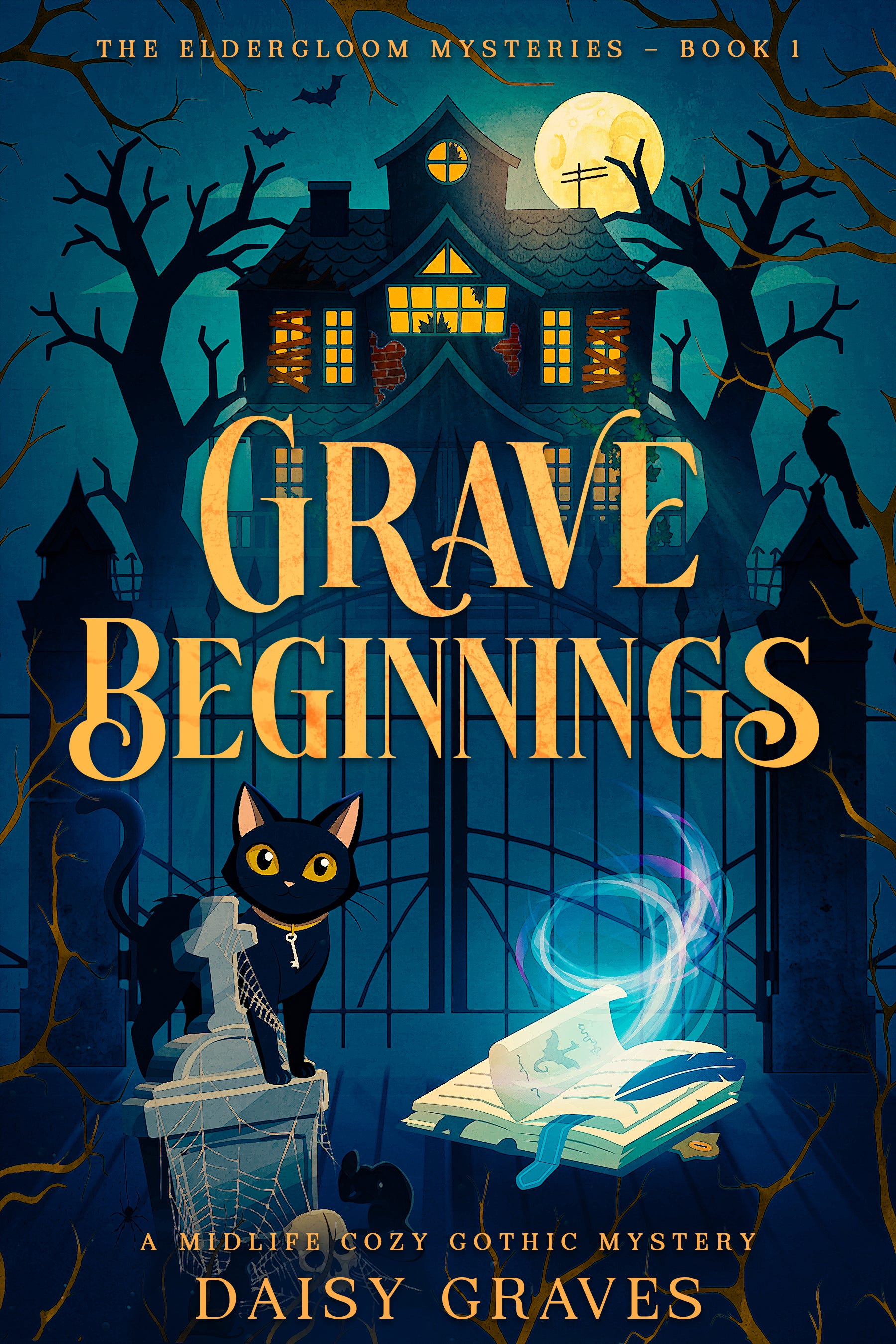
If you want to meet Hetty properly — the sigil-carved cane, the baking metaphors, the way she can make you feel both scolded and adored in the same sentence — she’s waiting for you in Grave Beginnings, the first book in the Eldergloom Mysteries. She’ll have opinions about you. She’ll be right about all of them.
And if you’re reading this at 3 a.m., on your kitchen floor, too hot and too tired and too much of everything — I see you. Hetty sees you. You’re not falling apart.
You’re rising. 🖤
With love and cold flannels,
Daisy
P.S. Bloom and Gloom, Book 2 of the Eldergloom Mysteries, is out now. Hetty’s in that one too. She brought scones. 🐾
Loved this! And it’s so on point.
I'm almost at that stage, and seeing these situations depicted with humor comes as a real relief. It was such an enjoyable read. I loved it.