


There’s something about a fog-drenched coastal town that makes secrets feel not just inevitable, but frankly unavoidable.
When I started writing Eldergloom, I wasn’t setting out to create a mystery series. I was trying to build a place I actually wanted to visit—good coffee, minimal small talk, and a community that accepts your weirdness because they’re far too busy managing their own.
I wanted a town where the houses lean slightly toward each other like they’re eavesdropping (because they probably are). Where the tea is strong, the gossip is tactical, and the supernatural is treated less like spectacle and more like a zoning issue. Of course there are vampires. Of course there are shifters. Of course the bookshop has a secret council chamber beneath it. Why wouldn’t it? That’s just good civic planning.
But more than that, I wanted a protagonist who felt real to me—not in a “relatable” marketing way, but in a “this is how actual humans navigate impossible situations” way.
Lenora Blackwell is forty-one. Recently divorced. Recently unemployed. Analytical enough that her friends find it endearing (mostly). She doesn’t believe in magic—not because she’s closed-minded, but because she prefers systems that can be debugged with enough coffee and a proper methodology.
Then she inherits a sentient Victorian manor sitting on a ley line nexus.
As one does.
What Eldergloom Is Actually About
At its heart, this series is about reinvention. Not the Instagram-friendly kind with vision boards and affirmations. The messier kind. The kind where you realize you’ve been second-guessing your own instincts for years and have to decide whether to start trusting yourself again—even when the evidence suggests you might be slightly psychic now, which complicates things.
Lenora’s magic—her Echo Sense—isn’t flashy. She doesn’t throw fireballs or summon storms. She notices patterns. Residual energy. Emotional imprints left behind like fingerprints. She reads the world the way she once read code.
Logic meets intuition. Spreadsheets meet specters.
And the Manor itself doesn’t need rescuing. It needs a keeper. It has opinions about paint colors and thinks most modern design trends are regrettable. It chooses its residents rather than the other way around.
That was important to me—the idea that sometimes the inheritance chooses you back.
The Community I Wanted to Build

Eldergloom is a town where supernatural beings hide in plain sight, not because they’re ashamed, but because it’s frankly easier than dealing with federal paperwork. There’s a vampire librarian who treats immortality as an excuse for excellent procrastination. A werewolf bartender who’s unfairly charming. A shopkeeper who communicates more through meaningful silences than most people do with entire TED talks.
And Shadow—an immortal cat wearing a silver pendant that glows when danger approaches, who absolutely knows who the murderer is in every book and refuses to explain his reasoning because apparently humans need to figure things out themselves.
It’s a found family story disguised as a murder mystery. Or maybe it’s a murder mystery disguised as a found family story. Either way, there are bodies, clues, and a cat with boundary issues.
Yes, I love a fair-play whodunit. But the real stakes, for me, have always been about belonging. About what happens when a community—even a slightly cursed one—decides to protect its own.
What I Didn’t Want
I knew early on what I didn’t want to write.
I didn’t want gore. I didn’t want cynicism dressed up as sophistication. I see enough of that elsewhere. I didn’t want a world that punishes kindness or treats softness like weakness.
Eldergloom is eerie, but it’s warm. The fog rolls in thick enough to muffle sound, but the lights stay on in the café. Justice is served alongside excellent scones. The cat gets fed (though he’ll act like he’s starving regardless).
Each book stands alone as a complete mystery. But underneath, there’s a slower current moving through: an ancient entity sealed beneath the Manor, a magical bureaucracy that would very much like to regulate everything, and a town that has survived centuries by being systematically underestimated.
And Lenora, learning—sometimes stubbornly—that independence and belonging aren’t actually opposites.
Where We’re Going Next
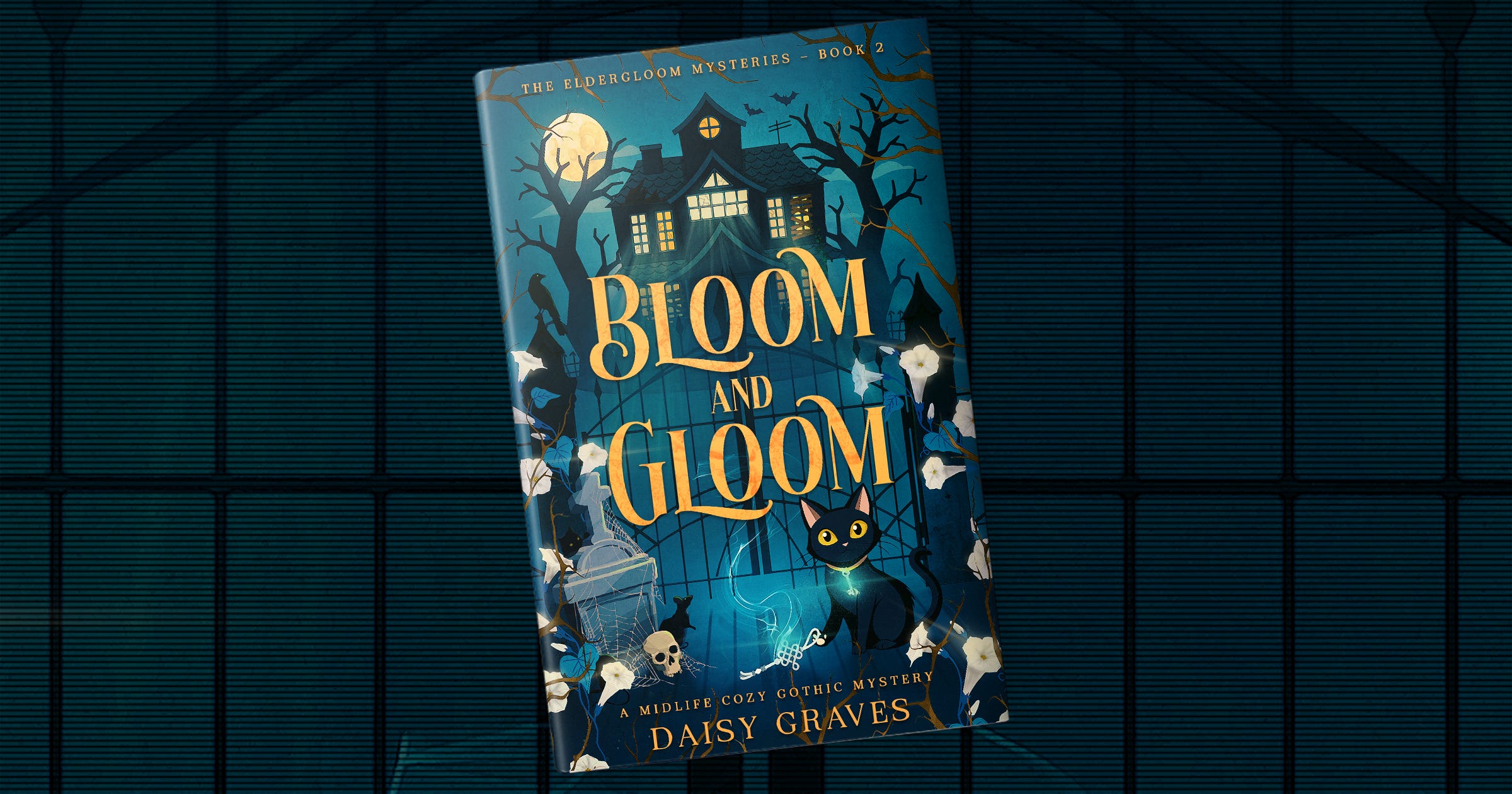
Right now, I’m deep in Bloom and Gloom (Book 2), and things are escalating in exactly the way I hoped they would.
The B&B is officially open. Festival lights are strung across the town square for Founder’s Day. A young vampire is dead under suspicious circumstances. Someone is hunting in plain sight, and the most dangerous thing in Eldergloom might not be the killer—it might be what’s stirring beneath the Manor’s floorboards.
The moonflowers are blooming. So is the darkness.
Why I’m Still Here
I built Eldergloom because I wanted a place that felt a little bit cursed and a little bit kind. A world where midlife is a beginning, not an ending. Where logic and magic coexist without apologizing for it. Where the house chooses you back, and the cat judges you for your life choices, and the community shows up when things get weird.
If you’re reading this, I’m genuinely glad you found your way here.
Welcome to Eldergloom. The fog is particularly thick today, but someone’s put the kettle on.
🕯️ Daisy